

MEASUREMENT
How we know the answers are right.
This is the method we use to score Ask Axon AI when you connect to your data from your AI tool.
There is no right answer to check against.
WHY THIS IS HARD
Ask Axon works differently to a model that returns text. You ask a question in plain English, the agent finds the relevant schema, writes SQL, runs it against your warehouse, and builds an answer out of the rows that come back.
That's the challenge when trying to measure it. There's no reference answer to compare against, there are several valid ways to write the same query, and the truth sits in your database at the moment you asked rather than today.
So the usual measures don't apply. Exact match, text similarity, benchmark leaderboards, none of them work when the answer depends on live data and there's no gold copy to check it against.
What we can measure is whether the answer holds together against its own evidence.
Whether the agent understood the question, whether the SQL was sound, whether the rows it got back actually contained the answer, and whether the final wording matches those rows.
That last one is the hallucination check. If the numbers in an answer aren't supported by the data the agent itself pulled, we score it wrong, including in the cases where it happens to be true.
WHAT WE SCORE
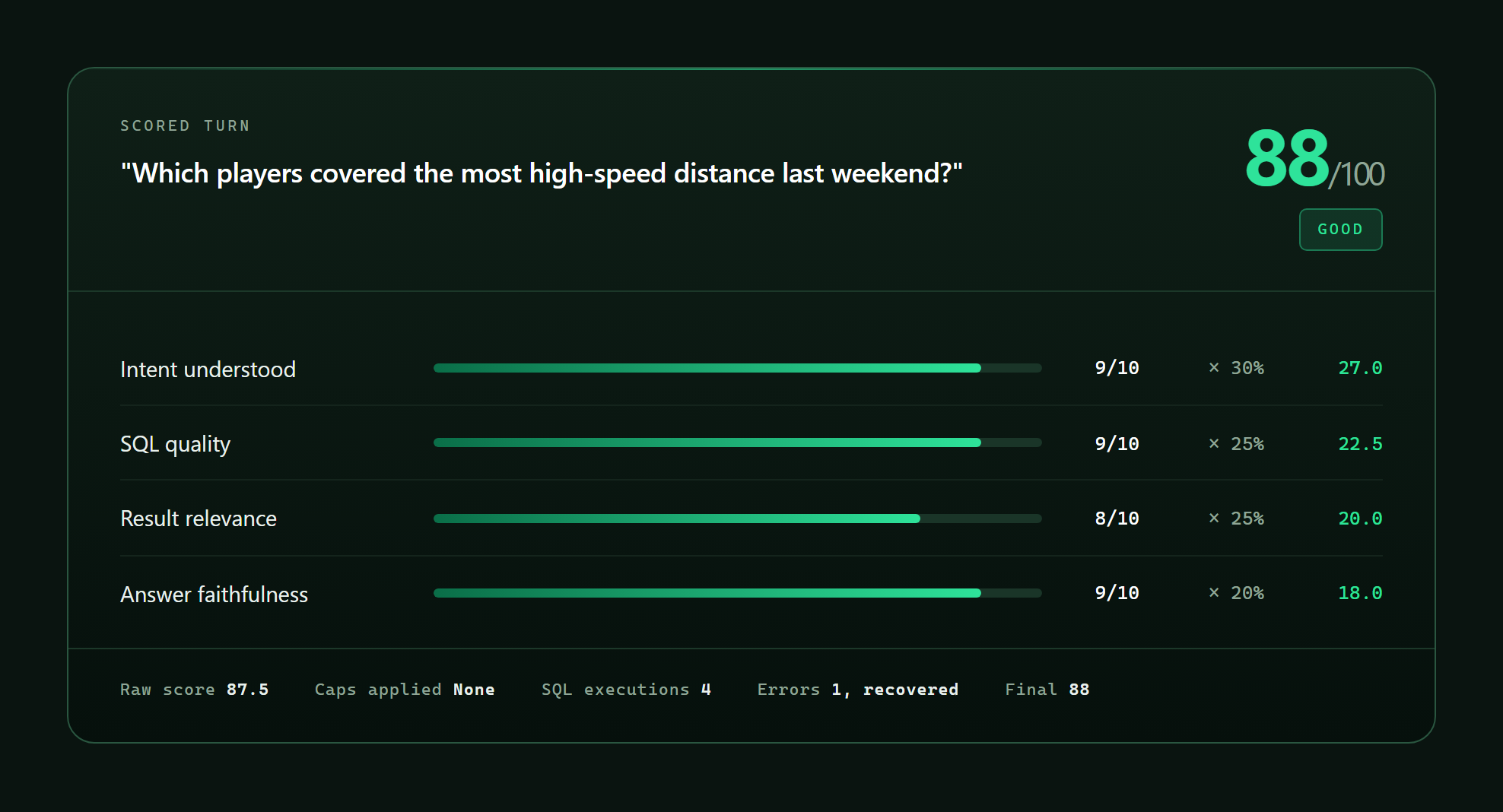
Four dimensions, weighted.
Every evaluated question gets scored on four things.
This one carries the heaviest weight because everything after it depends on getting it right. Well-written SQL pointed at the wrong question doesn't help anybody.
It scores full marks when no SQL was needed and none was run, so questions that don't require a query aren't penalised for it.
Full marks needs the set to be complete, so if seven tries were scored, all seven scorers come back rather than five of them.
This is the direct check for fabrication. Each dimension is scored 0 to 10, then weighted into a single score out of 100.